
In today’s increasingly digital world, ensuring that Software as a Service (SaaS) platforms are accessible to all users is not just a matter of ethical responsibility, but also a strategic imperative. This article aims to demystify accessibility compliance, specifically concerning the Web Content Accessibility Guidelines (WCAG), for SaaS providers. We will explore the core principles of WCAG, explain why achieving digital inclusion is crucial, and provide actionable insights for SaaS companies to build and maintain accessible platforms. Ignoring accessibility can lead to lost customers, legal ramifications, and reputational damage, making it essential to understand and implement effective accessibility strategies.
WCAG is the internationally recognized standard for web accessibility, providing a comprehensive set of guidelines for making web content more accessible to people with disabilities, including visual, auditory, cognitive, and motor impairments. With a global audience for most SaaS platforms, adhering to WCAG ensures a broader reach and improved user experience for everyone. This article will delve into practical steps, from understanding WCAG conformance levels (A, AA, and AAA) to implementing accessibility testing and remediation strategies, enabling SaaS platforms to achieve and maintain compliance while promoting digital inclusion for all users.
What is Accessibility Compliance and Why Does It Matter?
Accessibility compliance refers to the practice of designing and developing digital products and services that are usable by people with disabilities. This involves adhering to established standards and guidelines to ensure that everyone, regardless of their abilities, can access and interact with online content effectively.
Why does accessibility compliance matter? Firstly, it’s about inclusion. It allows individuals with disabilities to participate fully in the digital world, accessing information, services, and opportunities that would otherwise be unavailable. Secondly, it’s often a legal requirement. Many countries have laws mandating accessibility for websites and software, particularly for public sector entities and increasingly for private businesses. Finally, it’s good business practice. By making your SaaS platform accessible, you expand your potential user base and demonstrate a commitment to social responsibility, improving your brand image and customer loyalty.
Understanding WCAG: The Web Content Accessibility Guidelines
The Web Content Accessibility Guidelines (WCAG) are a set of international standards developed by the World Wide Web Consortium (W3C). They provide a single shared standard for web content accessibility that meets the needs of individuals, organizations, and governments internationally.
WCAG aims to make web content more accessible to a wider range of people with disabilities, including blindness and low vision, deafness and hearing loss, learning disabilities, cognitive limitations, limited movement, speech disabilities, photosensitivity and combinations of these. This accessibility encompasses all forms of electronic content on the web.
WCAG is structured around four core principles (POUR), and each principle has associated guidelines and success criteria. Meeting these success criteria is essential for achieving WCAG compliance.
There are different versions of WCAG. Currently, WCAG 2.1 is the most current version, offering improvements over earlier versions in the areas of mobile accessibility, users with low vision, and users with cognitive and learning disabilities. WCAG 2.2 is also available, with new success criteria designed to improve accessibility further.
WCAG Principles: Perceivable, Operable, Understandable, and Robust (POUR)
The Web Content Accessibility Guidelines (WCAG) are structured around four core principles, often remembered by the acronym POUR. These principles are fundamental to creating accessible web content.
Perceivable
Information and user interface components must be presentable to users in ways they can perceive. This means providing text alternatives for non-text content, offering captions and other alternatives for audio and video, ensuring content is adaptable (e.g., responsive design), and making it easier for users to see and hear content.
Operable
User interface components and navigation must be operable. This includes making all functionality available from a keyboard, providing sufficient time for users to read and use content, avoiding content that could cause seizures, and helping users navigate and find content.
Understandable
Information and the operation of the user interface must be understandable. This involves making text readable and understandable, ensuring that content appears and operates in predictable ways, and helping users avoid and correct mistakes.
Robust
Content must be robust enough that it can be interpreted reliably by a wide variety of user agents, including assistive technologies. This means maximizing compatibility with current and future user agents, including assistive technologies.
The Importance of WCAG Compliance for SaaS Platforms
For SaaS (Software as a Service) platforms, adhering to WCAG (Web Content Accessibility Guidelines) is not merely a suggestion, but a crucial element for fostering digital inclusion. It ensures that individuals with disabilities can effectively access and utilize the platform’s functionalities.
WCAG compliance expands the potential user base of the SaaS platform, reaching a wider audience and tapping into previously underserved markets. This commitment to accessibility demonstrates social responsibility and enhances the platform’s reputation.
Furthermore, compliance mitigates legal risks associated with accessibility non-compliance. Many jurisdictions have legislation mandating digital accessibility, and SaaS providers can face penalties for failing to meet these standards.
Ultimately, integrating accessibility from the outset improves the overall user experience (UX) for all users, not just those with disabilities. Clean, well-structured code and intuitive design benefit everyone.
Key Benefits of WCAG Compliance in SaaS
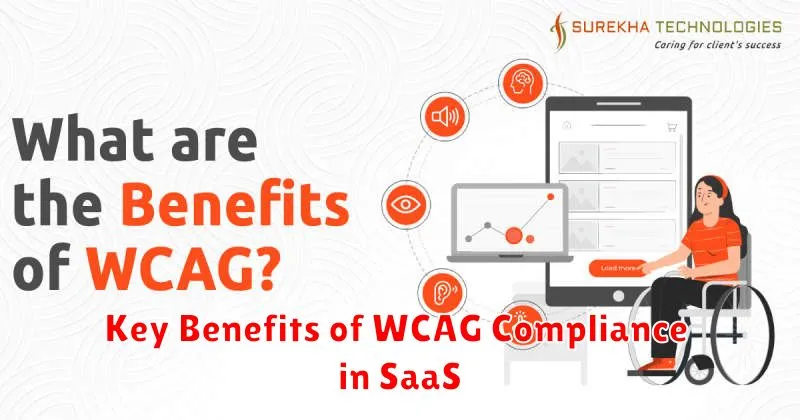
Implementing WCAG compliance within your SaaS platform provides a multitude of advantages, extending beyond mere regulatory adherence. It fosters a more inclusive user experience, broadening your potential customer base and enhancing brand reputation.
Expanded Market Reach: By adhering to WCAG, you make your platform accessible to individuals with disabilities, tapping into a significant and often overlooked market segment. This can lead to increased user acquisition and revenue streams.
Improved User Experience: Accessibility enhancements often result in a more intuitive and user-friendly interface for all users, not just those with disabilities. Clear navigation, logical structure, and alternative text can improve the overall user journey.
Enhanced Brand Reputation: Demonstrating a commitment to accessibility signals social responsibility and ethical business practices. This can strengthen your brand image and attract customers who value inclusivity.
Reduced Legal Risks: Compliance with accessibility standards can mitigate the risk of legal action related to discrimination against individuals with disabilities. Staying ahead of accessibility regulations can save your organization from potentially costly lawsuits and reputational damage.
SEO Benefits: Many accessibility best practices, such as providing alternative text for images and using semantic HTML, also improve search engine optimization (SEO), potentially leading to higher search engine rankings and increased organic traffic.
WCAG Compliance Levels: A, AA, and AAA
The Web Content Accessibility Guidelines (WCAG) define three levels of conformance: A, AA, and AAA. Each level builds upon the previous one, with AAA being the most comprehensive and demanding.
Level A is the minimum level of accessibility and addresses the most critical barriers for users with disabilities. Conformance to this level ensures that essential content and functionality are accessible.
Level AA includes all Level A criteria and adds further requirements to address a wider range of accessibility needs. This level is often considered the generally accepted target for web accessibility.
Level AAA is the highest and most comprehensive level of accessibility. While achieving this level may not be feasible for all content, it represents the ideal standard for accessibility and addresses the needs of the widest possible audience. Meeting AAA criteria requires significant resources and specialized expertise. SaaS platforms should strive to meet Level AA compliance as a baseline standard.
Common Accessibility Barriers in SaaS Applications
SaaS applications, despite their advantages, often present a range of accessibility barriers that can hinder users with disabilities. Understanding these barriers is the first step toward creating inclusive software.
Insufficient Color Contrast: Text and other visual elements may not have sufficient contrast against the background, making them difficult to read for users with low vision.
Lack of Keyboard Navigation: Users who cannot use a mouse rely on keyboard navigation. Inadequate keyboard support renders parts or all of the application unusable.
Missing or Improper Alt Text: Images without descriptive alt text are inaccessible to screen reader users, who cannot understand the image’s content.
Complex or Unclear Forms: Forms that lack clear labels, instructions, or error messages can be challenging for users with cognitive or visual impairments to complete.
Inaccessible Dynamic Content: Content that updates automatically without user interaction (e.g., carousels, auto-refreshing data) can be disorienting and difficult to control for users with disabilities.
Strategies for Achieving WCAG Compliance in SaaS
Achieving WCAG compliance in SaaS platforms requires a multifaceted approach. It’s not a one-time fix, but a continuous process integrated into the entire software development lifecycle.
Key Strategies:
- Accessibility Audit: Conduct a thorough audit to identify existing accessibility barriers.
- Inclusive Design: Incorporate accessibility considerations from the initial design phase.
- Accessible Code: Use semantic HTML and ARIA attributes to ensure content is properly structured and interpreted by assistive technologies.
- Keyboard Navigation: Ensure all functionalities are accessible via keyboard only.
- Color Contrast: Maintain sufficient color contrast between text and background.
- Testing and Validation: Regularly test with assistive technologies and automated tools.
- User Feedback: Gather feedback from users with disabilities to identify areas for improvement.
- Training: Provide training for developers and content creators on accessibility best practices.
By implementing these strategies, SaaS platforms can significantly improve accessibility and ensure a more inclusive experience for all users.
Tools and Resources for Accessibility Testing and Auditing
Achieving and maintaining WCAG compliance requires the strategic use of specialized tools and resources. These assist in identifying accessibility barriers and validating conformance with accessibility guidelines.
Automated Testing Tools
Automated tools like WAVE (Web Accessibility Evaluation Tool), axe DevTools, and Lighthouse can quickly scan SaaS platforms for common accessibility issues. They generate reports that highlight potential violations of WCAG guidelines.
Manual Testing Techniques
Manual testing involves human evaluation to assess aspects of accessibility that automated tools cannot detect, such as the usability of keyboard navigation and the clarity of content. This often includes screen reader testing with tools like NVDA or VoiceOver.
Accessibility Auditing Services
Engaging professional accessibility auditing services can provide comprehensive evaluations. These services offer detailed reports and actionable recommendations to improve the accessibility of your SaaS platform.
Browser Extensions and Plugins
Browser extensions offer on-the-fly accessibility checks. Many such extensions and plugins can assist in identifying issues while navigating the SaaS platform.
Maintaining Ongoing Accessibility Compliance in SaaS
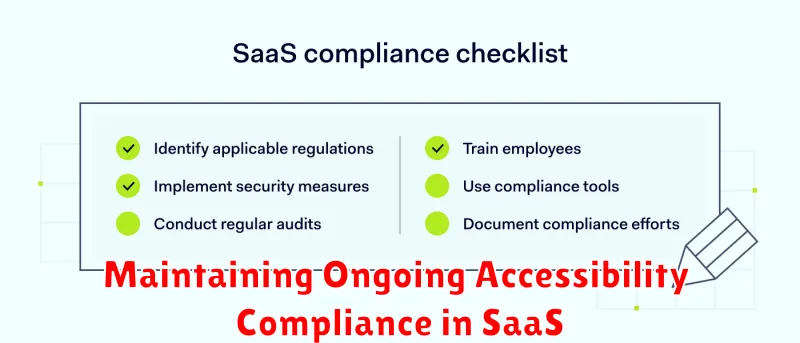
Achieving WCAG compliance is not a one-time task, but an ongoing process. SaaS platforms must establish a system for continuous monitoring, testing, and remediation to ensure sustained accessibility.
Regular Audits and Testing
Implement a schedule for regular accessibility audits, incorporating both automated and manual testing methods. Automated tools can identify common issues, while manual testing, particularly with users with disabilities, provides valuable insights into the user experience.
Continuous Monitoring and Remediation
Establish a system for monitoring user feedback and addressing accessibility issues promptly. This includes having a clear process for users to report barriers and a dedicated team to resolve them. Consider using accessibility monitoring tools that automatically scan for new issues.
Training and Education
Provide ongoing training and education to development, design, and content creation teams on accessibility best practices. This ensures that new features and content are accessible from the outset.
Policy Updates and Documentation
Regularly update accessibility policies and documentation to reflect the latest WCAG guidelines and best practices. This ensures that the organization’s commitment to accessibility is clear and well-documented.
The Legal and Ethical Implications of Accessibility in SaaS
WCAG compliance in SaaS is not merely a technical consideration; it carries significant legal and ethical weight. Legally, various countries and regions have enacted legislation mandating accessibility for digital products and services. Failure to comply can result in lawsuits, fines, and reputational damage. In the United States, the Americans with Disabilities Act (ADA) is often cited, while the European Accessibility Act sets standards across the European Union.
Ethically, SaaS providers have a responsibility to ensure their platforms are usable by everyone, regardless of disability. Digital inclusion promotes equality and empowers individuals with disabilities to participate fully in society. By neglecting accessibility, SaaS companies risk perpetuating discrimination and limiting opportunities for a significant portion of the population.
The intersection of legal mandates and ethical considerations underscores the critical importance of prioritizing WCAG compliance in SaaS development and maintenance. Proactive measures not only mitigate legal risks but also demonstrate a commitment to social responsibility and inclusivity.
