
In today’s interconnected digital landscape, OAuth 2.0 stands as the cornerstone of secure authorization. This industry-standard protocol enables seamless access to resources without sharing sensitive credentials, protecting user data and fostering a safer online environment. With its widespread adoption across countless applications and services, understanding the intricacies of OAuth 2.0 is paramount for developers, system administrators, and anyone involved in building or managing web and mobile applications. This article will delve into a comprehensive overview of OAuth 2.0, exploring its fundamental concepts, core components, and practical applications, while highlighting its critical role in ensuring secure authorization across the digital realm.
This in-depth exploration will demystify the complexities surrounding OAuth 2.0, breaking down its various grant types, tokens, and security considerations. We will examine how OAuth 2.0 empowers users to grant limited access to their information to third-party applications, such as social media platforms, without exposing their passwords or other sensitive data. Furthermore, we will discuss the best practices for implementing OAuth 2.0, addressing common vulnerabilities, and ensuring robust authorization mechanisms are in place to safeguard user privacy and data integrity. Whether you’re a seasoned developer or a curious newcomer, this article aims to provide a clear and comprehensive understanding of the ubiquitous OAuth 2.0 protocol and its critical role in the modern digital world.
What is OAuth 2.0 and Why is it Important?
OAuth 2.0 is an authorization framework that enables a third-party application to obtain limited access to an HTTP service, either on behalf of a resource owner or by allowing the third-party application to obtain access on its own behalf. It delegates user authentication to the service that hosts the user account, and authorizes third-party applications to access user data. OAuth 2.0 provides specific authorization flows for different application types. OAuth 2.0 supersedes the OAuth 1.0 protocol.
The importance of OAuth 2.0 lies in its ability to provide a secure and standardized way for applications to access resources without requiring users to share their credentials (e.g., usernames and passwords) with those applications. This enhances user security and privacy. By employing delegation of authorization, OAuth 2.0 mitigates the risk of credential compromise and offers a controlled mechanism for granting specific permissions. It is essential for modern web and mobile applications that interact with APIs and require secure access to user data.
Key Concepts in OAuth 2.0: Roles and Flows
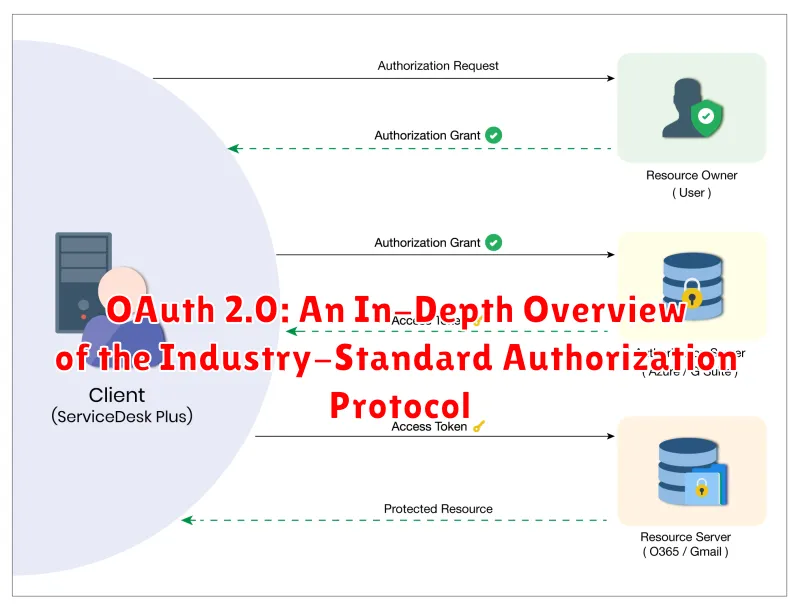
OAuth 2.0 involves several key roles interacting to facilitate secure authorization. These include:
- Resource Owner: The user who owns the data being accessed.
- Client: The application requesting access to the resource owner’s data.
- Authorization Server: Issues access tokens after successfully authenticating the resource owner and obtaining authorization.
- Resource Server: Hosts the protected resources and enforces authorization using access tokens.
The authorization flow describes the sequence of interactions between these roles. A typical flow involves the client requesting authorization from the resource owner, the authorization server issuing an access token, and the client using the access token to access protected resources on the resource server. The specific flow used depends on the type of client and the desired level of security.
The OAuth 2.0 Authorization Grant Types
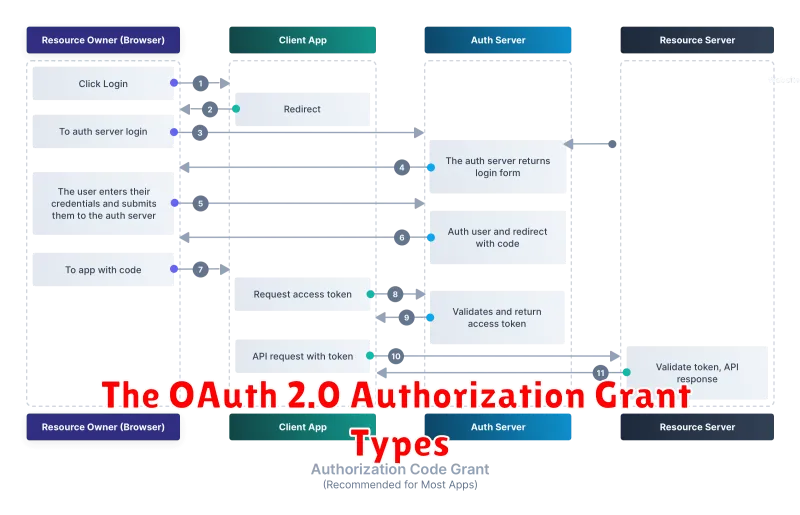
OAuth 2.0 defines several authorization grant types, each suited for different scenarios. These grant types dictate how an application obtains an access token.
Here are the most common grant types:
- Authorization Code Grant: Used for web applications where the client can securely maintain a client secret. Involves a redirect back to the client application with an authorization code, which is then exchanged for an access token.
- Implicit Grant: Simplified flow for browser-based applications where the client secret cannot be safely stored. Returns the access token directly. Note: This is generally discouraged due to security concerns.
- Resource Owner Password Credentials Grant: Allows the client to obtain an access token by directly providing the resource owner’s username and password. Use this only with trusted applications.
- Client Credentials Grant: Used when the client is acting on its own behalf (not on behalf of a user). Useful for machine-to-machine authorization.
- Refresh Token Grant: Used to obtain a new access token using a refresh token. This allows long-lived access without requiring the user to re-authorize.
Understanding OAuth 2.0 Tokens: Access, Refresh, and ID Tokens
OAuth 2.0 relies heavily on tokens to manage authorization and access to protected resources. These tokens come in three primary types: Access Tokens, Refresh Tokens, and ID Tokens. Each serves a distinct purpose in the OAuth 2.0 flow.
Access Tokens
An Access Token is a credential that represents the authorization granted to the client. It is used to access protected resources on behalf of the resource owner. Access tokens typically have a limited lifespan.
Refresh Tokens
A Refresh Token is used to obtain a new access token without requiring the resource owner to re-authorize the client. This is especially useful when the access token expires.
ID Tokens
An ID Token is a JSON Web Token (JWT) that contains information about the authenticated user. It is primarily used for authentication purposes and provides verifiable claims about the user’s identity.
OAuth 2.0 Scopes: Limiting Access and Permissions
OAuth 2.0 scopes are a fundamental mechanism for limiting the amount of access that an application can obtain on behalf of a user. They define the permissions that the application is requesting, ensuring that it only gains access to the resources it actually needs.
Think of scopes as specific contracts between the user and the application. Instead of granting unrestricted access, the user approves a limited set of actions. For example, an application might request the ‘read_profile’ scope to access basic user information but not the ‘write_posts’ scope to publish content on their behalf.
Scopes are typically defined as strings, often concatenated with spaces or other delimiters. Common examples include:
profile: Access to basic profile information.email: Access to the user’s email address.read_contacts: Permission to read the user’s contacts.write_posts: Permission to create posts on behalf of the user.
By using scopes effectively, developers can enhance the security and privacy of their applications, minimizing the risk of unauthorized access and data breaches.
OAuth 2.0 Security Considerations and Best Practices
OAuth 2.0, while powerful, necessitates careful attention to security. Improper implementation can lead to vulnerabilities.
Key Security Considerations
- Token Storage: Never store tokens in client-side code (e.g., JavaScript). Use secure server-side storage.
- HTTPS Only: Always use HTTPS to protect against man-in-the-middle attacks.
- Input Validation: Thoroughly validate all inputs to prevent injection attacks.
- Regular Updates: Keep your OAuth 2.0 libraries and implementations up to date to patch security vulnerabilities.
Best Practices
- Principle of Least Privilege: Request only the scopes necessary for your application’s functionality.
- Token Expiration: Use short-lived access tokens and refresh tokens.
- Refresh Token Rotation: Implement refresh token rotation to mitigate the impact of compromised tokens.
- Auditing and Logging: Maintain detailed logs of OAuth 2.0 transactions for security monitoring.
OAuth 2.0 vs. OpenID Connect: What’s the Difference?
While often used together, OAuth 2.0 and OpenID Connect (OIDC) serve different purposes. OAuth 2.0 is primarily an authorization protocol, enabling third-party applications to access specific resources on behalf of a user without requiring their credentials. It’s about granting access.
OIDC, on the other hand, is an authentication protocol built on top of OAuth 2.0. It provides a standardized way to verify the identity of a user. It answers the question “Who is this user?”. OIDC introduces the concept of an ID Token, a JSON Web Token (JWT) containing claims about the authenticated user.
In essence, OAuth 2.0 authorizes access; OIDC authenticates users. OIDC leverages OAuth 2.0’s authorization framework to securely transport user identity information. Think of it this way: OAuth 2.0 gets you into the building; OIDC checks your ID at the door.
Implementing OAuth 2.0 in Your Applications: A Practical Guide
Implementing OAuth 2.0 in your applications requires careful planning and execution. Start by selecting an appropriate OAuth 2.0 library or framework for your chosen programming language. These libraries abstract away much of the complexity involved in the protocol.
Next, register your application with the Authorization Server (e.g., Google, Facebook, or your own custom server). This registration will provide you with a Client ID and Client Secret, which are essential for identifying your application during the authorization process.
Implement the desired Authorization Grant Type based on your application’s needs (e.g., Authorization Code, Implicit, Client Credentials). Ensure that you properly handle the exchange of authorization codes for access tokens and securely store the tokens. Validate tokens before granting access to protected resources.
Finally, always adhere to security best practices, such as using HTTPS, validating redirect URIs, and implementing token revocation mechanisms.
Benefits of Using OAuth 2.0 for Secure Authorization
OAuth 2.0 offers several significant advantages when implementing secure authorization in applications. Primarily, it enhances security by allowing users to grant limited access to their resources without sharing their credentials with third-party applications. This delegated authorization model reduces the risk of credential compromise.
Another key benefit is the improved user experience. Users can seamlessly authorize applications using their existing accounts, streamlining the login process and increasing adoption. This reduces friction and improves overall user satisfaction.
Enhanced security and improved user experience translates to greater trust. By using OAuth 2.0, your application can demonstrate its commitment to data privacy and security, fostering greater user confidence.
OAuth 2.0 Use Cases: Real-World Examples
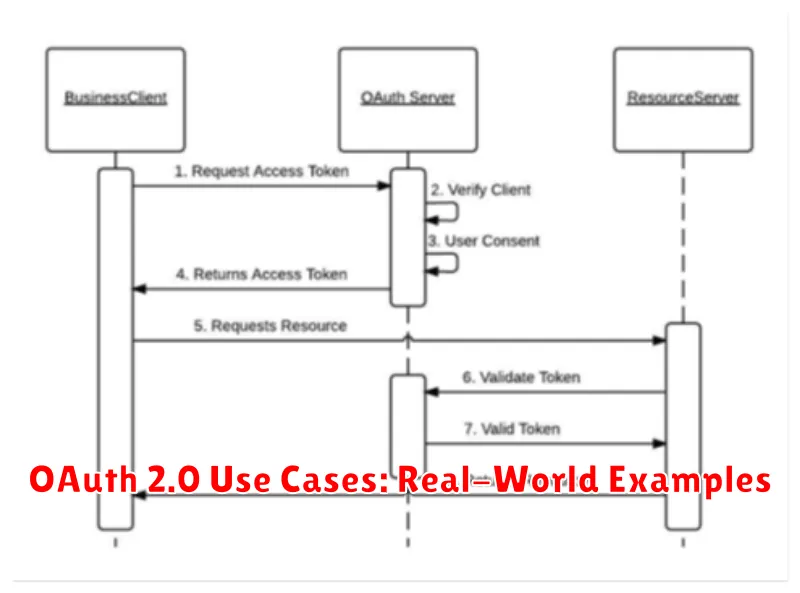
OAuth 2.0 is widely adopted across various industries due to its flexibility and security. Understanding its real-world applications helps to illustrate its importance.
Social Login: A primary use case is allowing users to log into third-party applications using their existing accounts from providers like Google, Facebook, or Twitter. This simplifies the user experience by eliminating the need to create new credentials.
API Access Delegation: Many APIs use OAuth 2.0 to grant limited access to resources. For instance, a fitness app might request access to a user’s health data from a wearable device, allowing it to track activity levels.
Cloud Storage Integration: Applications can use OAuth 2.0 to access files stored in cloud storage services like Dropbox or Google Drive, enabling seamless integration and data sharing.
IoT Device Authorization: OAuth 2.0 can be employed to authorize devices in the Internet of Things (IoT) ecosystem, ensuring secure communication and data exchange between devices and services.
